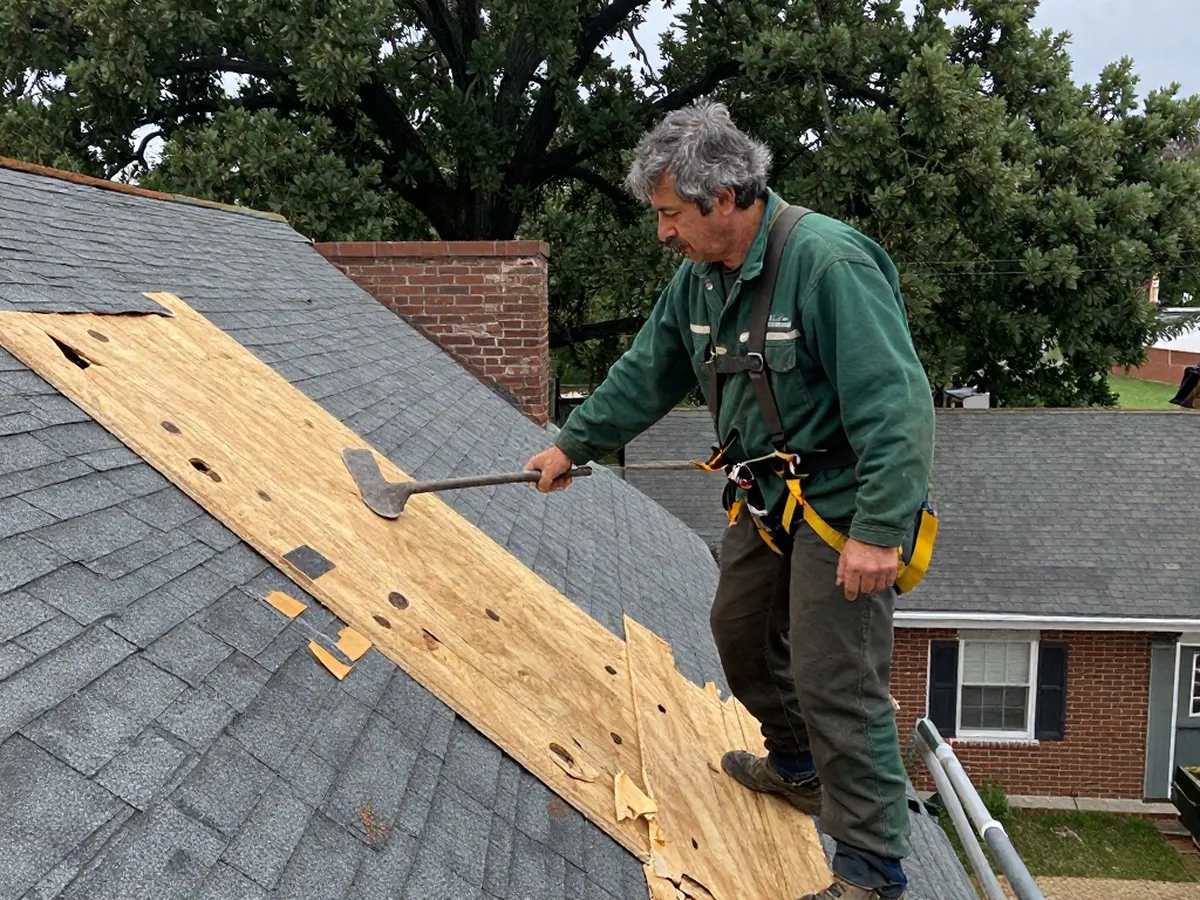
How long does a roof last?
The sources opened here speak plainly about one material. The National Park Service says properly installed slate typically lasts 60 to 125 years or longer, depending on the slate, the roof's shape and its location, and some slates have lasted more than 200 years.
For asphalt shingles, none of the pages opened gives a lifespan. The roof's own condition, seen from the attic and the yard, is the better guide.
Why do the metal parts wear out first?
The Park Service notes that because slate is so durable, metal flashings often wear out before the slate does. The roofing manufacturers' association calls flashings the weakest points on a roof and says to inspect their underside at every flashing point.
The Building America guide shows the layering at a chimney: step flashing woven with the shingles, topped by counterflashing set into a brick mortar joint. Every one of those joints is a place for time and weather to work.
What does the attic have to do with ice outside?
Almost all of it, according to UMass. Heat that leaks into the attic warms the roof deck and melts snow; the water slides down to the cold overhang and freezes there, forming the dam. The guide names weak insulation and air sealing as the root problem, with ceiling insulation of R-38 or more advised for the northern United States.
Building America's guide ranks the steps the same way: seal the air leaks between the living space and the attic first, then insulate, then vent along the whole underside of the roof.
Can the ice just be chipped off?
The UMass author advises against it, on the grounds that chipping puts people and roofs at risk without touching the cause. A roof rake can clear snow, though it may scrape granules off asphalt shingles. Electric heat cable gets a worse review: the author has never seen it cure an ice dam and says it creates one just above itself.
At the Caldwell airport weather station, January's normal average is 30.6 degrees, with daily highs and lows on either side of freezing.
What is ponding on a flat roof?
The roofing manufacturers' association counts water as ponding once it has sat on the roof for two days or more. Its aim is a surface that falls a quarter of an inch or more per foot, so rain runs off freely.
Standing water can flex the deck, expose the membrane to repeated freezing and thawing and feed algae. On a house, the surfaces to check are the low-slope ones, such as a porch roof or an addition.
Six one-line answers
- How old is too old for slate?
- The Park Service says properly installed slate lasts 60 to 125 years or longer.
- What is the 10 percent rule?
- A 2003 field guide recommends a new roof when more than a tenth of the old one needs repair.
- What is counterflashing?
- The cap piece that covers the top edge of step flashing, set into a mortar joint on a chimney.
- Does a gutter cause an ice dam?
- The UMass guide says no; heat escaping into the attic does.
- How long makes it ponding?
- Water left standing for 48 hours or longer after rain.
- Who decides to repair or replace?
- The contractor, after a look; the rules of thumb only frame the question.
Which of these sounds like your roof?
An old roof with leaks in several places belongs on the roof replacement page. A roof that is simply due for a careful look belongs on the roof inspection page. Call (862) 396-4866 with the roof's age and where it leaks, and ask to talk through the options.